Case StudyAgentic Intake & AI‑First Onboarding Vision
Designing an AI‑guided intake that configures HubSpot around real customer goals
Project Overview
As HubSpot shifted toward AI‑First Onboarding, we wanted to move beyond static checklists and generic “getting started” flows. The goal was to design an agentic intake experience that:
Understands a new customer’s goals, context, and constraints
Uses those signals to intelligently configure the CRM and onboarding surfaces
Hands off into a more focused, opinionated onboarding system (User Guide, Grow Guide, Global Home) instead of overwhelming users with every possible task at once
This case study covers how I framed the problem, defined the Agentic Intake + Onboarding system, and created UX guardrails other teams could safely build on.
Problem
New customers often landed in a portal that felt:
Generic: Everyone saw the same tasks, regardless of their business model or maturity
Fragmented: Setup lived in separate surfaces (signup, User Guide, Grow Guide, Global Home) that didn’t share context
High effort: Users had to configure pipelines, lists, and views manually before they could do any meaningful work
We needed an AI‑first flow that could collect intent and context once, use it to set up the portal intelligently, and then thread that context through the rest of onboarding.
Role & Team
My role: Senior IC Product Designer (later moving into management), acting as:
Pattern & UX DRI for the Agentic Intake slice
Author of requirements and UX guardrails for the agent and how its output shows up across onboarding surfaces
Connector between Agentic, Nav, Grow Guide, and onboarding teams
Partners:
PMs and Eng leads on AI‑First Onboarding
Designers on Nav, Global Home, User Guide / Grow Guide
Data / ML partners responsible for how signals power configuration
Solution at a Glance
We framed Agentic Intake as one part of a larger system:
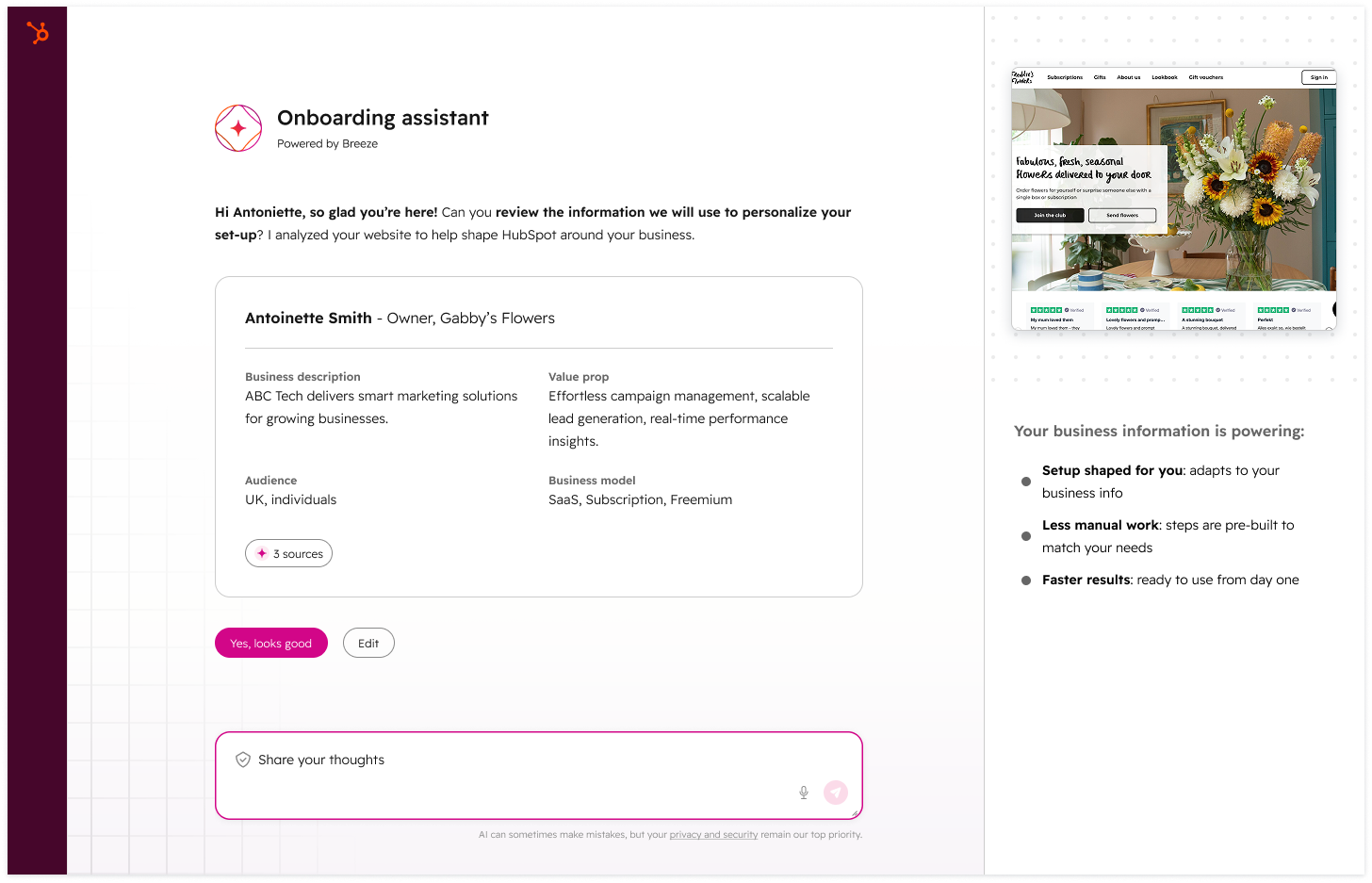
Agentic Intake – collects goals, use cases, team structure, data sources, and constraints through a guided, conversational flow.
Smart Configuration – uses those inputs plus existing signals (sign‑up path, installed tools) to propose initial configuration: pipelines, lists, key objects, and views.
Review & Confirm – shows users exactly what the agent plans to change, with clear, reversible actions.
AI‑Aware Onboarding Surfaces – User Guide, Grow Guide, and Global Home reflect the same goals and configuration, surfacing just enough work to move customers to value quickly.
Process
1. Framing the system
I started by mapping the end‑to‑end journey:
Signup → Agentic Intake → Smart Setup / Review → AI‑aware Guides → Global Home
For each step I captured:
What the user is trying to accomplish
What context we already know
What new signals we should ask for (and when)
Which team owns the surface and underlying systems
This mapping became the backbone for team charters and ownership docs, making it clear where the Agentic team stops and where onboarding / nav teams begin.
2. Defining requirements & guardrails for Agentic Intake
I then wrote a focused requirements doc for the agent, covering:
Inputs:
Business type and goals (e.g., “book more meetings”, “move deals through a simple pipeline”)
Team composition (solo founder vs. sales team vs. agency)
Existing tools (e.g., Gmail, calendar, other CRMs)
Outputs:
Recommended configuration (pipelines, stages, key objects)
Smart tasks and checklists tailored to their goals
Hooks into data synchronization and enrichment (see Case Studies 2–3)
For the UX, I set explicit guardrails:
Always show what the agent is proposing to change, before it happens
Provide simple controls: accept all, accept with edits, or skip
Make AI choices legible and reversible – clear copy on “why this was suggested”, easy undo, and a log of major changes
Avoid turning intake into an interrogation; keep interactions short, progressive, and visually calm
These guardrails were written so that multiple teams could implement agentic patterns without reinventing safety, copy, or review/confirm logic.
3. Connecting Agentic output to onboarding surfaces
Working with designers on User Guide, Grow Guide, and Global Home, I translated the agent’s output into surface‑specific requirements:
User Guide / Grow Guide
Show a short, sequenced set of tasks tied directly to the goals captured in intake
Reduce generic “learn HubSpot” tasks; emphasize “do something real” (e.g., send a first email, import existing warm contacts)
Global Home
Show high‑signal cards anchored in what the agent just set up (e.g., “Review your new pipeline”, “Check imported contacts”)
Treat the home experience as a live reflection of what the agent has configured, not a separate checklist
I documented these expectations so each surface could design within its own constraints while still feeling like one connected onboarding system.
4. Patterns & collaboration
Because Agentic Intake touched many teams, I invested early in reusable patterns:
Intake prompt templates (how we word goals, trade‑offs between open vs. structured questions)
Review & Confirm UI patterns – modals, summary views, change logs
Microcopy and tone guidelines so the agent felt friendly but not chatty or opaque
I used design reviews, async Looms, and shared Figma libraries to socialize the patterns and keep new explorations aligned as other teams picked up agentic work.
Outcomes
A clear, written vision for Agentic Intake as part of an AI‑First onboarding system, not a standalone chatbot.
Reusable UX guardrails and patterns (intake, review/confirm, AI attribution) that other teams could adopt.
Better cross‑team alignment: onboarding, nav, and AI teams all working from the same journey map and expectations, which reduced overlap and conflicting designs.
Customer impact
In FO‑010, Agentic onboarding delivered a +13% relative lift in customers reaching their first goal versus the legacy flow, with the lift concentrated in people who actually completed the Agentic path.
Even though today only ~15% of Free signups complete Agentic, that group reaches their first goal much more reliably than skippers, validating the experience itself and pointing to completion rate as the biggest opportunity.
Agentic intake is now fully rolled out to 100% of Free signups across CRM, Marketing, Sales, and Service (EN), so every new Free portal sees the improved experience from day one.
Business impact
Across experiment cycles, the Agentic variant consistently showed an ≈+13% relative lift in monetisation, driven largely by the fact that Agentic completers monetise at ~3× the rate of those who skip.
These results justified rolling Agentic out from experiment to global default for English Free signups and investing in: (1) surfaces that increase entry into Agentic, (2) speeding up completion time, and (3) re‑entry points for users who skipped on first run.
Agentic now acts as a core growth lever for Free, and the underlying patterns and guardrails are being reused as we expand the experience to Starter, upgraders, and Pro customers.